The History of Washington Square Park


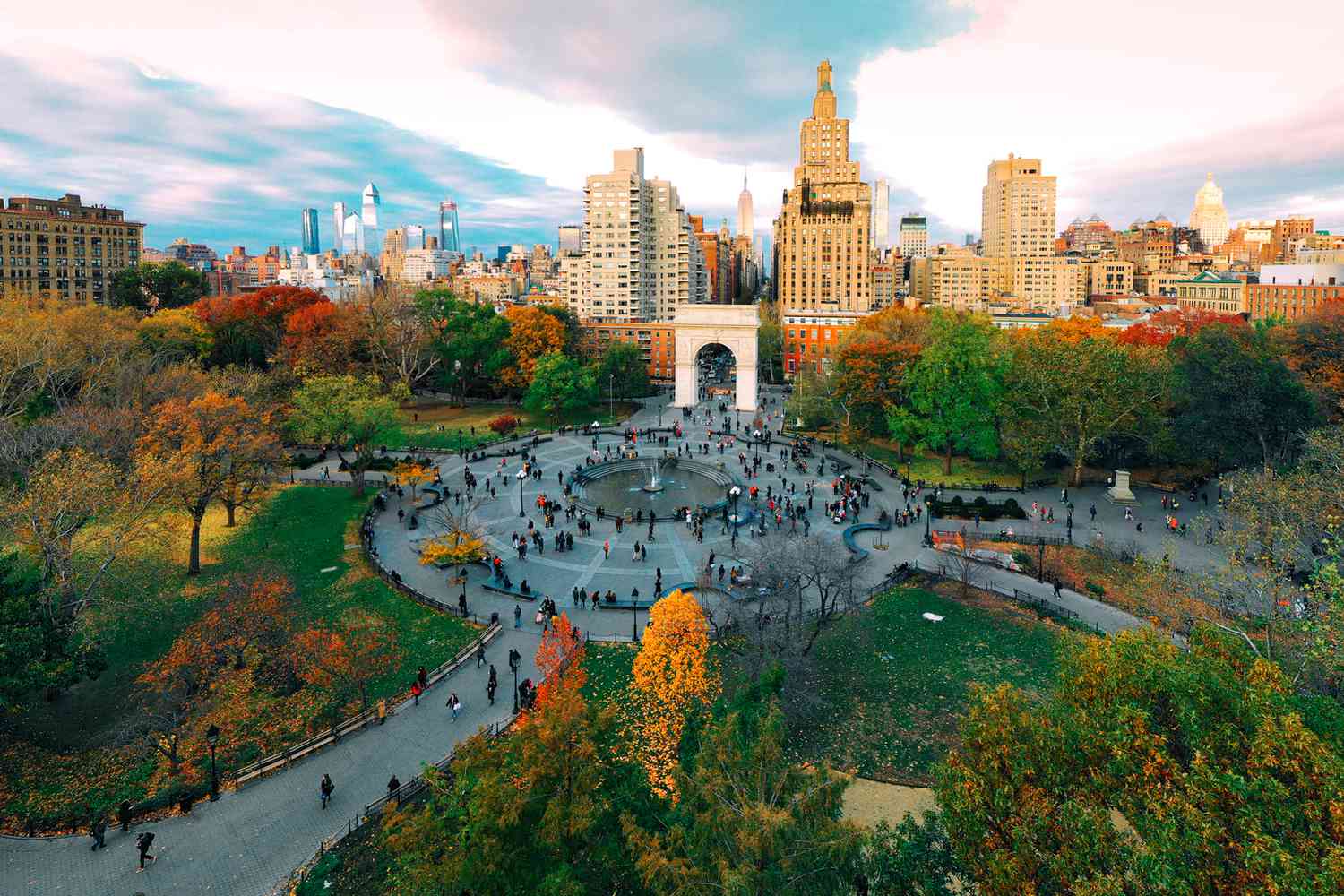
Washington Square Park is just 9.75 acres, but don't let that fool you. Anchored by Stanford White's iconic Washington Square Arch and sitting at the heart of Greenwich Village, it has more history, culture, and community woven into its grounds than most places ten times its size. For nearly two centuries it has been a place to linger, play, protest, perform, and simply exist, beloved by locals and irresistible to visitors from around the world.

From Marshland to Meeting Place
Long before there was a park, the Lenape people knew this land as a marshy ground crossed by a trout stream called Minetta Creek. In 1624, the Dutch West India Company established a trading outpost at the southern tip of Manhattan, and by 1642 the director of New Amsterdam had freed a number of enslaved Africans and granted them plots of land to farm, some of which overlapped the site of the future park. Those free Black farmers eventually lost their land under English rule, and their property was absorbed into large private estates.
A City's Burial Ground
Beginning in the late 1700s through the early 1800s, the site served as the city's potter's field, a public burial ground for the poor, the unknown, and the many victims of the yellow fever epidemics that repeatedly swept through New York. More than 20,000 people are estimated to rest beneath the park's grounds today.
One of them was James Jackson, a 28-year-old Irish immigrant and watchman who died of yellow fever on September 22, 1799, and whose sandstone headstone was unearthed during pre-renovation archaeological work in 2009. At the time, potter's fields were largely reserved for the unidentified and the indigent, buried in unmarked graves, which makes the existence of James' stone all the more mysterious and remarkable. It can still be seen today in the Park House window, a tangible link to the thousands of lives that came before the lawns and pathways we walk today.
By 1826, the filled cemetery was converted into the Washington Military Parade Ground, declared on the 50th anniversary of the Declaration of Independence, and the neighborhood around it began its transformation into one of Manhattan's most coveted addresses. In 1827, the City of New York purchased additional parcels near the Washington Military Parade Ground and officially declared the combined land a public square.
A Neighborhood on the Square
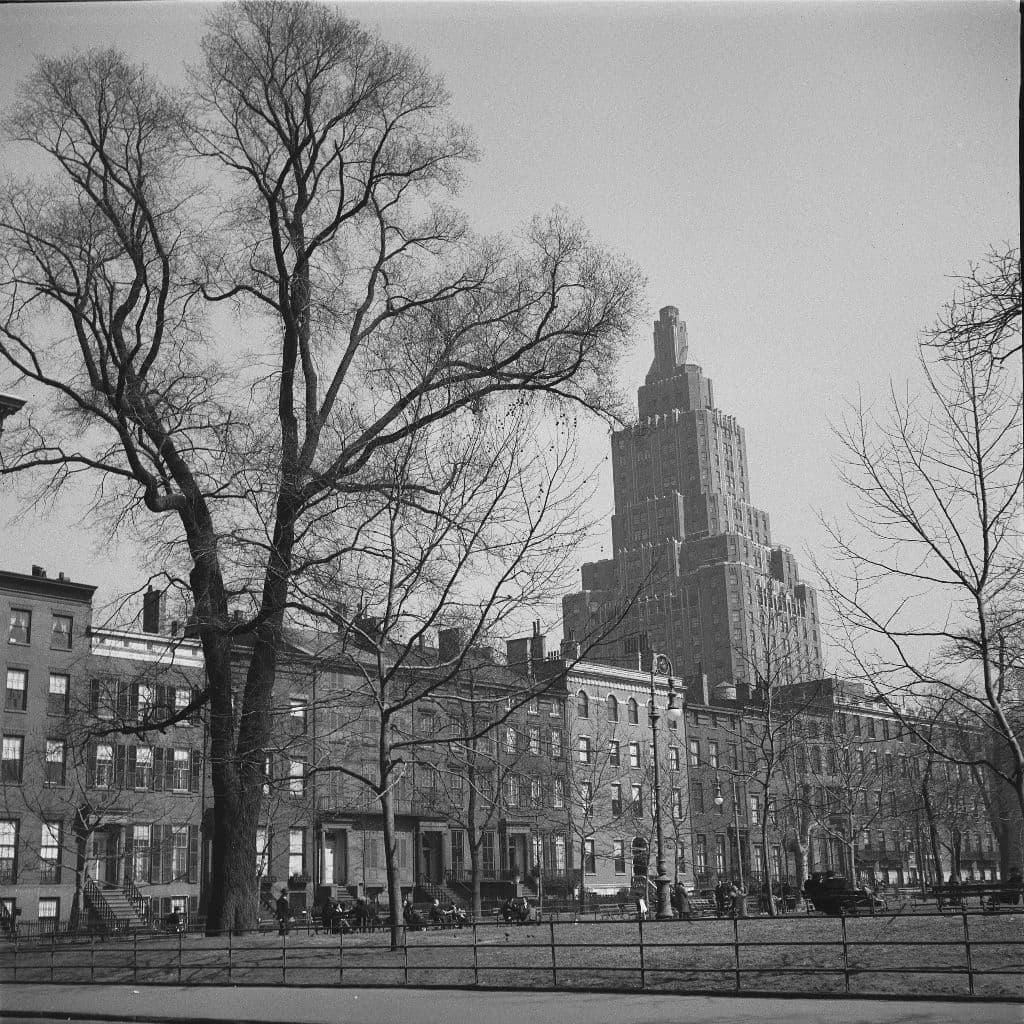
Within a few years of the formation of Washington Military Parade Ground, elegant houses were built on its borders. On the east side stood NYU's first home, a Gothic Revival building where Samuel Morse perfected his telegraph and Winslow Homer painted on the rooftop. The area soon became known as Washington Square, esteemed for its patriotic associations and genteel society. Henry James, who visited his grandmother's house at 18 Washington Square North as a boy in the 1840s, later immortalized the neighborhood in his novel “Washington Square”, writing that the area had, "the kind of established repose which is not of frequent occurrence in other quarters of the long shrill city."
The Park Takes Shape
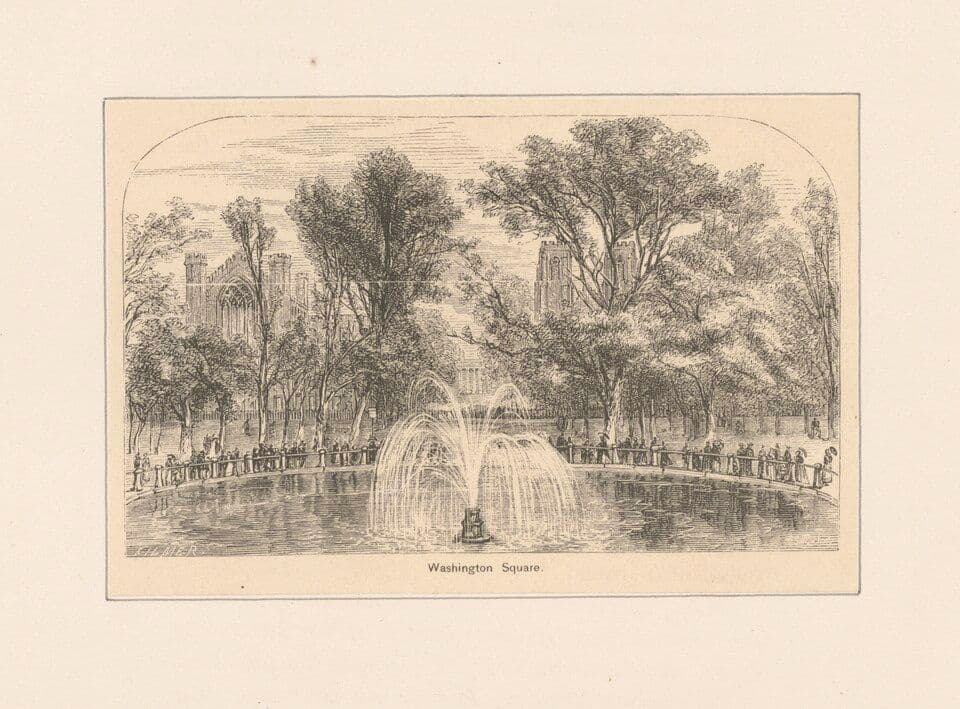
In 1870, Boss Tweed's newly formed Department of Public Parks tasked Ignaz Pilate, a colleague of Frederick Law Olmsted, with redesigning Washington Square. They started by replacing the parade ground's rigid military geometry with the curving pathways and gathering spaces that still define the park today. A restored fountain, originally from Central Park's 59th Street entrance, was installed at the park's center.
Then came the Arch. In 1889, Stanford White designed a temporary plaster arch to celebrate the centenary of George Washington's inauguration, and it was such a sensation that a permanent marble version was commissioned. The Washington Square Arch was formally dedicated on May 4, 1895, and has anchored the park ever since. Its two prominent sculptures, Washington at War (1916) by Herman Atkins MacNeil and Washington at Peace (1918) by A. Stirling Calder, were added to the pedestals in the years that followed.
Art & Activism
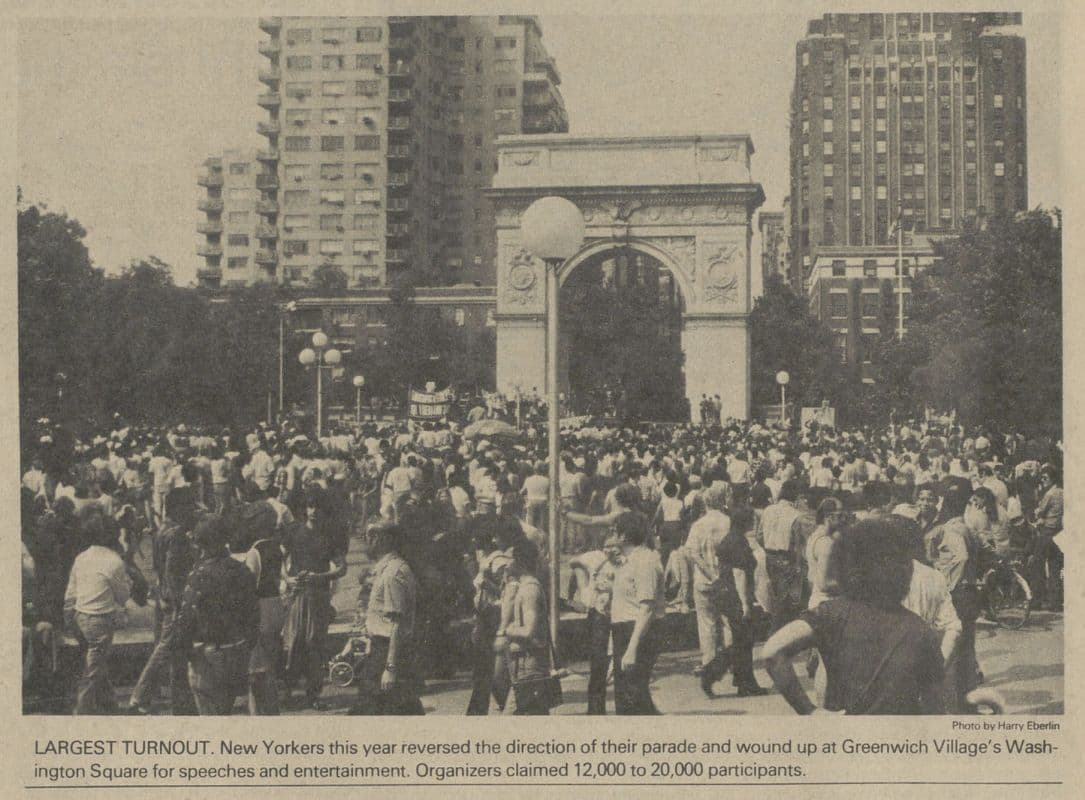
By the early 20th century, Greenwich Village had become the beating heart of American bohemian life, drawing artists, writers, and radicals from across the country. Washington Square Park bore witness to some of the era's most defining moments: in 1911, thousands of mourners marched silently through the park following the devastating Triangle Shirtwaist Factory fire one block away, which claimed 146 lives, mostly young immigrant women. The following year, more than 20,000 workers marched under the Arch on Labor Day to rally for better working conditions.
The park's most dramatic chapter may be its battle with Robert Moses. Beginning in 1935, the all-powerful Parks Commissioner pushed repeatedly to carve a roadway through the park to connect Fifth Avenue to lower Manhattan. For three decades, a tenacious coalition of Greenwich Village residents fought back. Jane Jacobs, who would go on to write “The Death and Life of Great American Cities” in 1961, was among the most influential voices in that fight, championing the park as a model of what vibrant, people-centered urban space could and should be. In 1958, Greenwich Village became the only community to defeat Robert Moses. With the roads closed and the park car-free for the first time, the fountain plaza emerged as a prime performance space. Joan Baez, Bob Dylan, Allen Ginsberg, and the Beat poets all found their footing here.
Renovation and Renewal
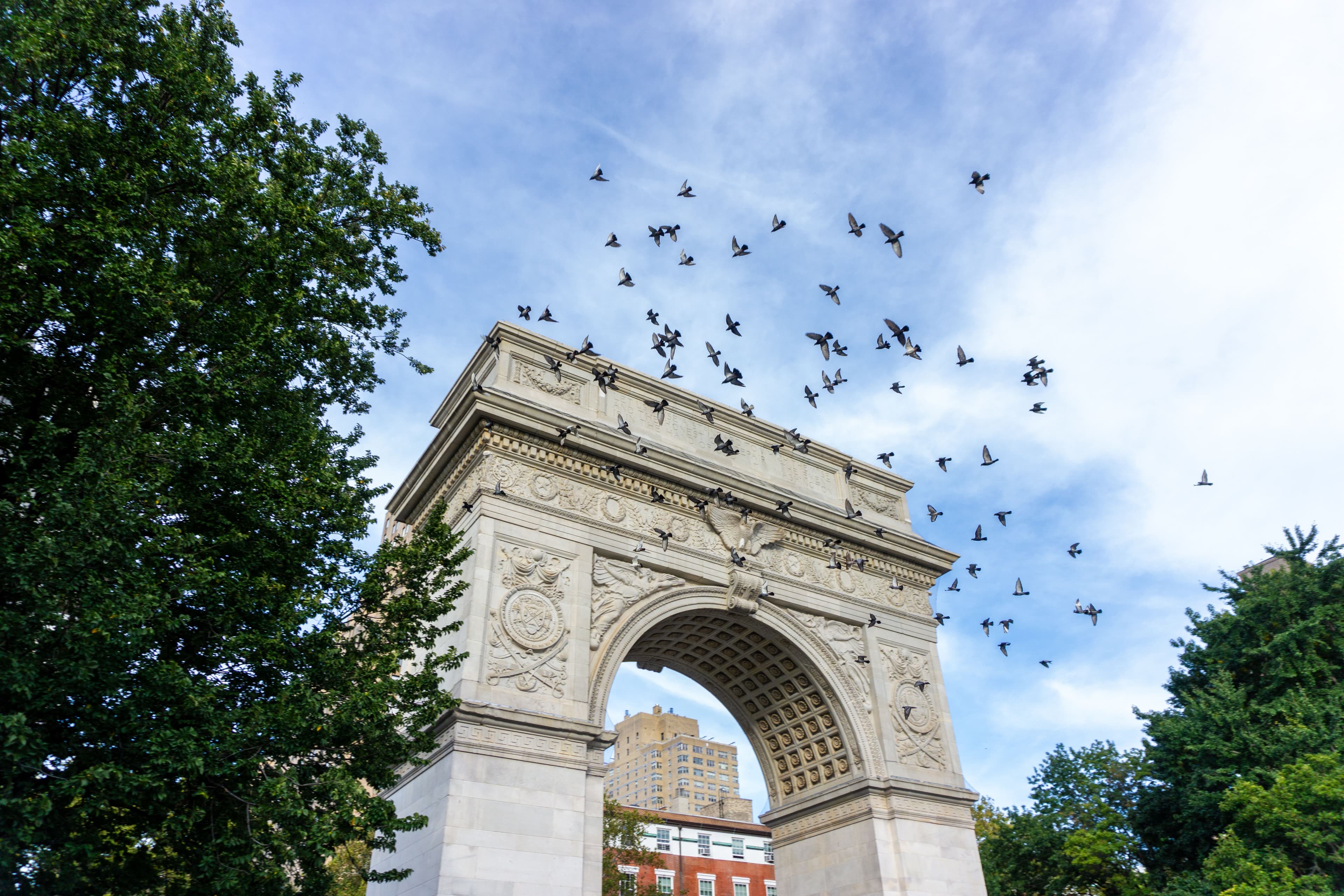
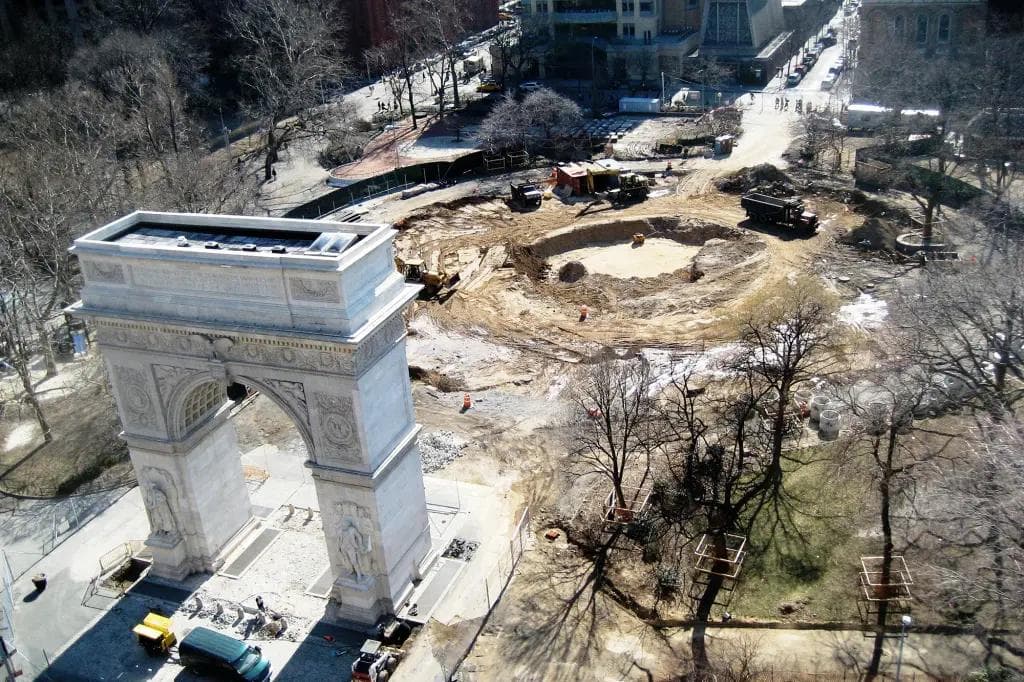
Washington Square Park becoming car-free prompted a rethinking of its design. In 1970, Robert Nichols, a renowned poet and playwright, led a community-driven renovation that opened up the central fountain area into a sweeping sunken plaza. This redesign also led to the creation of the stage and the petanque court, two notable features of the park today. In 2004, the Washington Square Arch received a full restoration, including structural stabilization, conservation of its marble facade, and the addition of architectural lighting. It was rededicated on April 30th of that year, the 215th anniversary of Washington's inauguration, and received preservation awards from both the Greenwich Village Historical Society and the New York Landmarks Conservancy.
The most recent renovation, completed in 2014, transformed the park in two major phases. The first tackled the northwest quadrant, bringing new and expanded lawns and planting beds, repaved paths, new benches and lighting, and restoration of the Alexander Holley Monument. At the center of the park, the iconic fountain was completely rebuilt and restored to its original dimensions, now serving as the focal point of a fully accessible, level plaza. The second phase turned its attention to amenities and gathering spaces, including the playgrounds, stage, petanque court, chess plaza, small dog run, and sitting areas. Finally, a brand new LEED Certified Park House was rebuilt on the footprint of the old structure.
The Conservancy
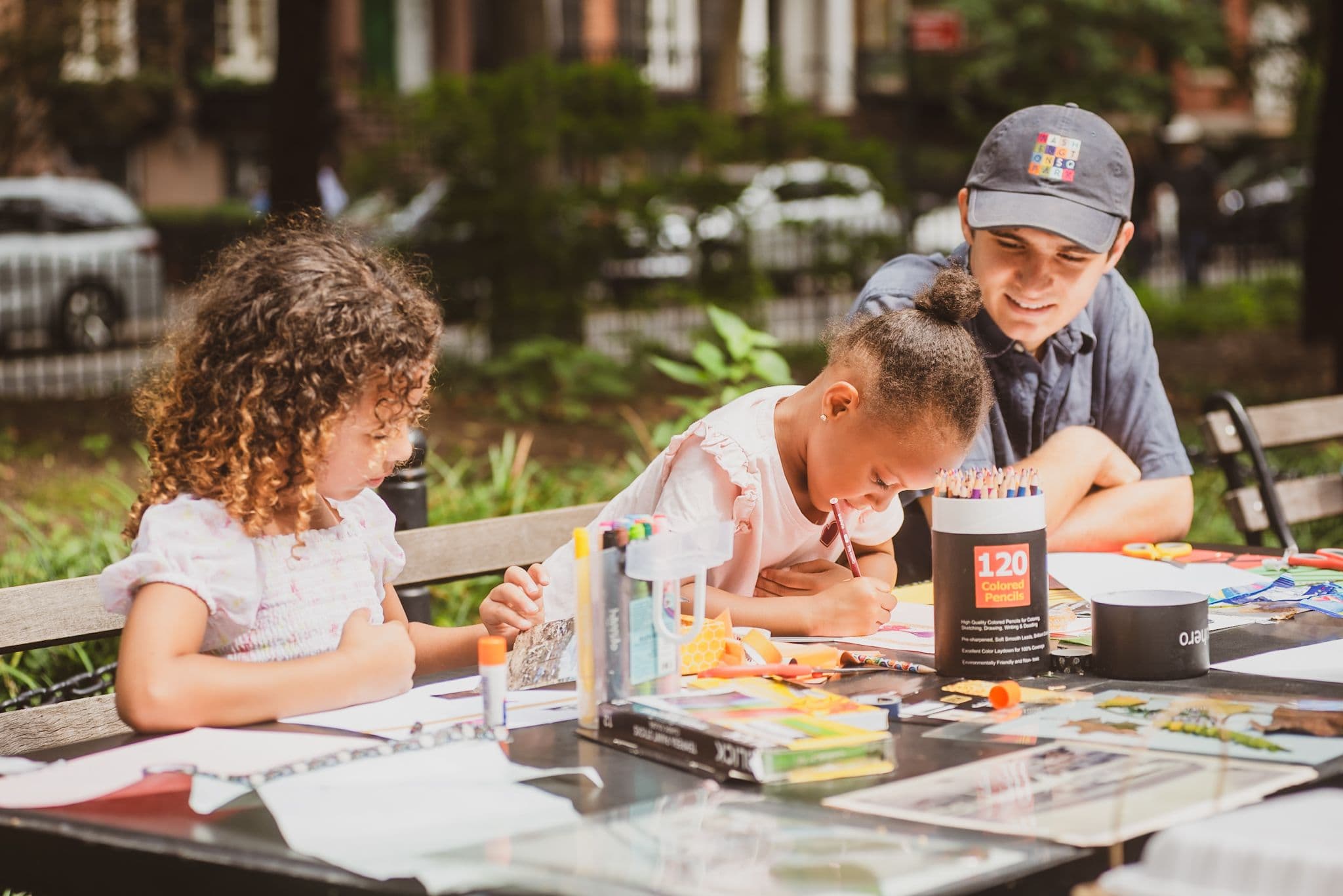
The city's $30 million capital renovation gave Washington Square Park a renewed foundation, but keeping a park that hosts more than 12 million visitors a year thriving takes more than a one-time investment. That's where the Washington Square Park Conservancy comes in. Founded in 2012 by local leaders who recognized the critical need for ongoing support, the Conservancy works in partnership with NYC Parks to enhance and preserve a vibrant community green space in the heart of New York City for all who are drawn to its iconic grounds.
After more than a decade of growth, community building, and dedication to its mission, the Conservancy reached a landmark milestone in 2025 when it was officially approved for a license agreement with NYC Parks, making WSPC the official nonprofit partner of Washington Square Park. It's a fitting next chapter for a park that has always belonged to its community, and a commitment to ensuring it remains a vibrant, well-cared for gathering place for generations to come.